
On Student Press Freedom Day, Iowa should be proud. After all, this is the state that gave the nation Tinker v. Des Moines, the Supreme Court ruling that affirmed students do not “shed their constitutional rights to freedom of speech or expression at the schoolhouse gate.”
But pride is not protection.
Student journalists are watching what happens to professionals in Iowa. They see a publisher sued by a president, a journalist arrested at a protest, and an editor forced to sue for access to the statehouse. The message is unmistakable, even if it is not new: power has never welcomed scrutiny. What is new is the willingness of American institutions to abandon pretense and punish it in plain sight.
Journalists in the United States have been labeled the “enemy of the people.” The U.S. Press Freedom Tracker reported that assaults on journalists in recent years have “steadily increased.”
That is a disturbing rise in physical assaults, arrests, and lawsuits against individuals who are simply doing their jobs. As of February 2026, at least 42 journalists have been assaulted and six were arrested or criminally charged while reporting in the U.S.
In 2025, those numbers were even higher: At least 186 were assaulted and 35 arrested or charged. These figures do not include the journalists who had their equipment damaged, seized, or those who were sent subpoenas or legal orders. Increasingly, reporters are forced to sue police just to protect their right to work — a costly and pervasive reality.
If reporting the truth can land a professional journalist in handcuffs, in a lawsuit, or in the hospital, what message does that send to the young reporters still finding their voices? Student journalists, who operate with far fewer resources and protections, are watching. The effect is: You risk being harmed if you want to publish unfavorable information.
But to understand where this threat is heading, we need to look at one state that most readers will be able to connect with: Iowa.
Iowa: A Microcosm of the Crisis
Iowa holds a unique place in First Amendment history. In 1965, students in Des Moines wore black armbands to protest the Vietnam War and were suspended. The Supreme Court case Tinker v. Des Moines Independent Community School District, affirmed that students do not “shed their constitutional rights to freedom of speech or expression at the schoolhouse gate.”
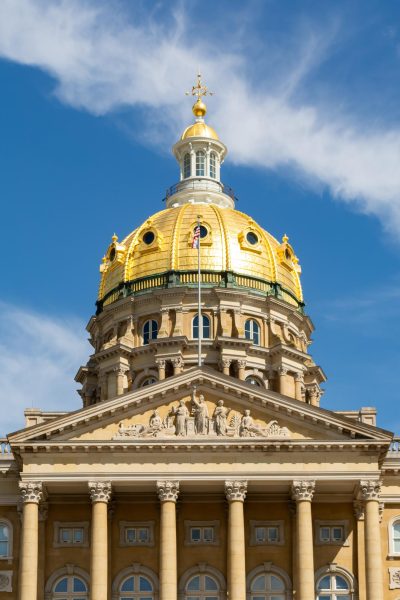
But in Iowa 2026, that legacy feels like ancient history. Today, the state has become a testing ground for nearly every tactic used to intimidate and silence the press.
In December 2024, President Donald Trump filed a lawsuit against the Des Moines Register, its parent company, Gannett, and pollster Ann Selzer. The suit alleges “brazen election interference” and fraud regarding a pre-election poll that showed Kamala Harris leading in Iowa — a state Trump ultimately won by 13%.
The “chilling effect” is no longer a metaphor — it’s the goal. And when billionaires take aim in civil court, they know they have the resources to win — or simply to make the point that they’re not afraid to sue, even when the law isn’t on their side. Either way, the press loses.
While the courts are used as a weapon, the legislature has become a gatekeeper. Since 2022, Republican leaders in the Iowa Senate have barred journalists from the chamber floor, ending a 140-year tradition of press access near lawmakers’ desks. What’s the message? The watchdogs need to stay out.
The Iowa House has engaged in its own credentialing issues. For years, it denied press credentials to Laura Belin, a journalist and sole editor of Bleeding Heartland. Belin was forced to file a federal lawsuit in early 2024 before the House finally granted her access. She had to sue for the right to do her job — a job the Constitution exists to protect.
The Legislature’s strategy extends beyond locking the press out of the building — it’s about controlling what happens on campus so there’s nothing left to report on. Iowa lawmakers have introduced bills targeting diversity, equity, and inclusion programs across public universities, with proposals that would strip funding from institutions that maintain DEI offices or teach certain content.
The state legislature has indirectly made it clear that either you comply with the ideological mandates, or lose millions in state and student aid. The University of Iowa even opened a new Center for Intellectual Freedom in response — an entity born not from a desire to encourage debate, but from political pressure to preempt it. Control what students are taught, and you control what they think to ask. Control what they think to ask, and you control what eventually bleeds into the press.
The hostility is not only bureaucratic, but also physical. In 2020, Des Moines Register reporter Andrea Sahouri was pepper-sprayed and arrested while covering a Black Lives Matter protest. She identified herself as press. None of it mattered. She was charged with failure to disperse and interference with official acts. A jury acquitted her of all charges in 2021, but the damage was done. The message here? Your credentials will not always protect you.
And the warnings keep coming. In late 2023, Iowa Attorney General Brenna Bird wrote to several national news organizations, including The Associated Press and Reuters. The subject of her letter? That their coverage of international conflicts could constitute “material support for terrorism.” It’s a stretched claim, but that is precisely the point. The goal is not to go to court. It is to cast fear and doubt on journalists.
Student Journalism Matters
If this is what professional journalists face in Iowa, what might happen to the students?
Consider The Indiana Daily Student at Indiana University, where administrators ordered the paper to cease its print edition and fired the faculty adviser after disputes over editorial control.
In Nebraska, a high school newspaper was shut down for covering Pride Month. At Purdue, administrators cut support for The Purdue Exponent, citing “neutrality.” These are symptoms of a broader national trend — a growing discomfort with scrutiny. A trend that has only worsened with time.
As I said before, power has never welcomed scrutiny. That is not new to history. What is new is the normalization of punishing it openly — not behind closed doors, but on podiums, in lawsuits, and on social media feeds.
It would be easy to dismiss student journalism as a training exercise. Easy, but wrong. Students have reported budget shortfalls, scrutinized Title IX processes, highlighted discriminatory policies, and revealed the truth that has even reshaped student life. They are the ones holding small authorities accountable before those authorities grow into larger ones.
If we allow that work to be silenced — by lawsuits, by threats, by a culture that scorns the truth — we are not just failing student journalists. We’re failing democracy.
When we normalize retaliation against the press, we teach the next generation that truth is conditional — and accountability optional.
Conclusion
The attacks on press freedom are not hypothetical. They are not coming. They are here. And they are unfolding in plain sight in states like Iowa.
If we truly value freedom of the press, we must do more than invoke it when convenient. We must defend it when it is inconvenient. We must defend it for the professionals facing lawsuits and attacks on the front lines, and for the students waiting in the wings.
If we believe in the First Amendment, then it cannot be a slogan we repeat to avoid social repercussions. It must be a principle we defend when a reporter is sued, when a student paper is silenced, when access is revoked, and when scrutiny makes power uneasy. Support local news. Defend student publications. Demand transparency from those who govern.
Because the next generation of journalists is already doing its job. The rest of us need to decide whether we will do ours.